
Check Palm Springs Voter Registration
Start with the California Secretary of State’s My Voter Status service when checking your own Palm Springs voter registration. The state describes it as the place to confirm the name under which you are registered and your political party registration. It is a self-lookup, not a search box for browsing other Palm Springs voters. If the online service fails or a voter prefers help by phone, the Secretary of State’s registration-status page lists Riverside County at (951) 486-7200 for status checks.
The practical walkthrough is short. Open My Voter Status, follow the live prompts, and enter only information for your own record. Review the returned status and party details, then call the Riverside number if the system cannot match the registration. The research capture encountered an anti-bot response, so the live input labels could not be verified. They are intentionally not guessed below.
| Lookup item | Input type | Required | Verified guidance |
|---|---|---|---|
| Live My Voter Status fields | Not captured | Not captured | The official portal exists, but its field labels were blocked during static inspection. |
| Riverside County phone check | Phone call | As requested by staff | Use (951) 486-7200 and ask about your own voter registration status. |
The official Palm Springs voter lookup screen is shown in the captured view below.
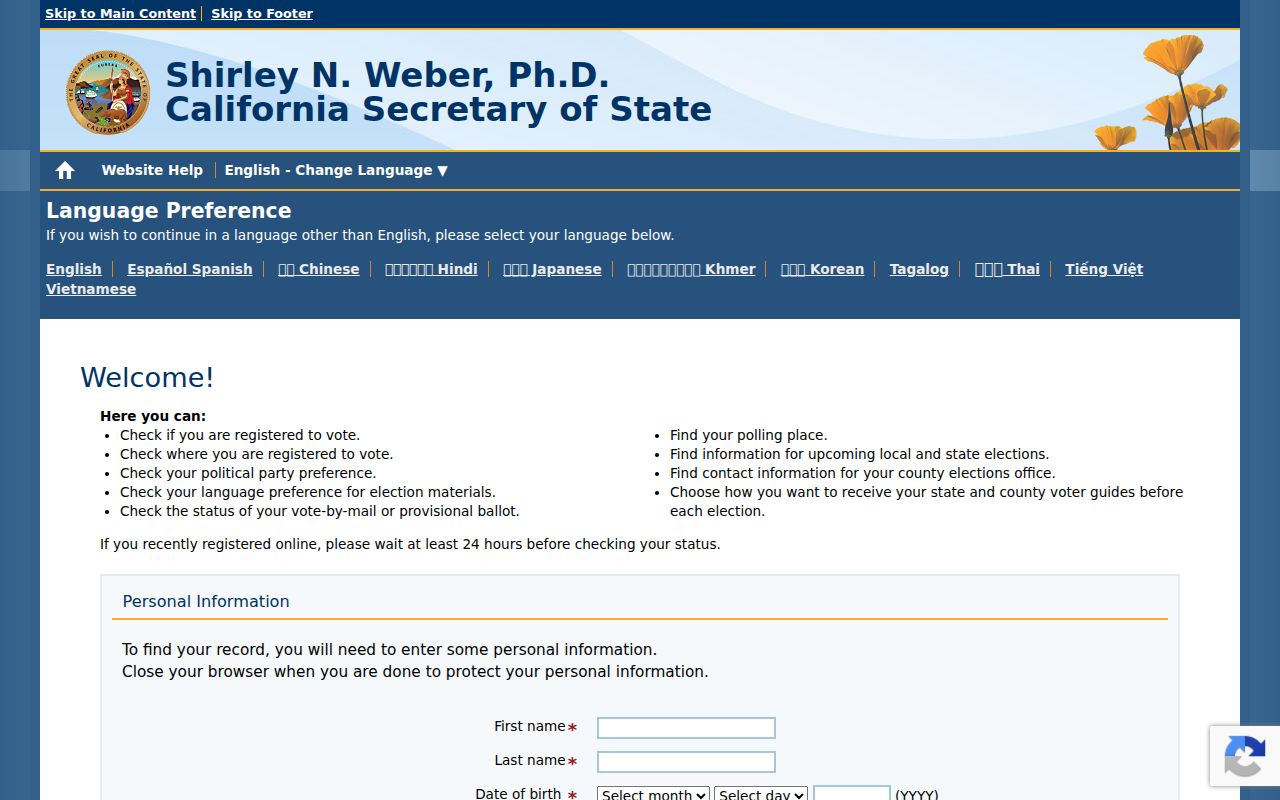
The capture also shows why a blocked or gated web session should lead to the Riverside County phone fallback, not to assumed search fields.
Note: My Voter Status is for personal verification; it does not turn California’s restricted voter rolls into a public name directory.
Palm Springs Voter Records Stay Restricted
A common myth treats voter registration as ordinary open-directory data. California takes the opposite approach. The Secretary of State’s voter-file application states that voter registration information is not public data. Candidates, qualifying committees, and people with election, scholarly, journalistic, political, or governmental purposes may seek access under state rules. Curiosity about a Palm Springs neighbor is not one of the listed grounds.
Qualified applicants may seek a statewide file from the Secretary of State or ask a specific county. Some registration records remain confidential and are not supplied even to an approved requester. This restricted structure differs from ordinary municipal records. For general California Public Records Act timing and city or county request channels, use the separate Palm Springs public records access resource.
California’s confidentiality line. Elections Code sections 2188, 2194, and 18109, Government Code section 7924.000, and regulations sections 19001-19013 restrict access, disclosure, and use. Signatures, Social Security or identification numbers, and protected-voter data are not routine public fields.
Palm Springs Voter Record Inventory
California regulations define a broad voter-record inventory, but that does not mean each field appears in every Palm Springs record or is open to everyone. The definition applies only to data included in an individual record, and access depends on an approved purpose. A voter’s own self-lookup may show personal status or party details without granting access to the underlying statewide voter file.
| Identity | Name, unique registration identification number, and county voter identification number may be included in the restricted file. |
|---|---|
| Addresses | Residential and mailing addresses may appear, subject to confidential-record and Safe at Home protections. |
| Contact and profile | Phone, email, language preference, date of birth, gender, place of birth, and party preference can be part of a record. |
| Registration details | County, status, status reason, registration date, method, precinct, and voting-assistance request status may be included. |
| Election details | Permanent vote-by-mail status and participation history may be available to an approved requester. |
This field list comes from California’s access-to-voter-registration-information regulations. It is a sample inventory of what the regulated record can contain, not a promise that My Voter Status displays each item.
Palm Springs Voting History Explained
Voting participation history records whether someone took part in an election and the voting method. It does not reveal a ballot choice. California’s definition separates participation data from the private act of voting, so no Palm Springs voter-file result should be read as proof of how a person voted on a candidate or measure.
An approved applicant can ask that voting history be included with a statewide file. The application also offers precinct-to-district data. Both are optional data selections tied to the requester’s stated, approved purpose. The distinction matters for civic and scholarly work: turnout patterns may be studied, but individual choices remain secret.
Protecting Palm Springs Voter Addresses
California’s Safe at Home program provides an official address-confidentiality route for eligible survivors and other protected people. The program can provide a substitute mailing address for use in government records and mail. For a Palm Springs resident facing a real safety risk, that structured program is more useful than trying to remove an address one record at a time.
Separate election rules also protect certain confidential voter records. The Secretary of State’s request materials note that some records are withheld, while Elections Code section 2166.9 addresses confidential contact information for specified elected officials and candidates in bona fide journalistic or governmental contexts. An applicant should never assume approval overrides those protections.
Note: Safety-sensitive Palm Springs voters should review Safe at Home eligibility and enrollment before sharing a current residence address in public-facing channels.
Who Can Request Palm Springs Voter Data
The California voter-file request process accepts applications from defined users and for defined purposes. Eligible groups include candidates for federal, state, or local office and committees supporting or opposing a properly published initiative or referendum. Individuals may also apply for election, scholarly, journalistic, political, or governmental work, subject to the Secretary of State’s review.
Approval is not automatic. The applicant must identify the organization type, explain the intended use, describe security, and name any beneficiary. Palm Springs records sit within the Riverside County portion of the statewide system. The research did not locate a separate Riverside County fee or county application page, so the verified statewide process is the sound route for detailed instructions. The Riverside phone line remains the local channel for checking one’s own status.
The state registration-status page with the Riverside contact appears in the second successful capture.
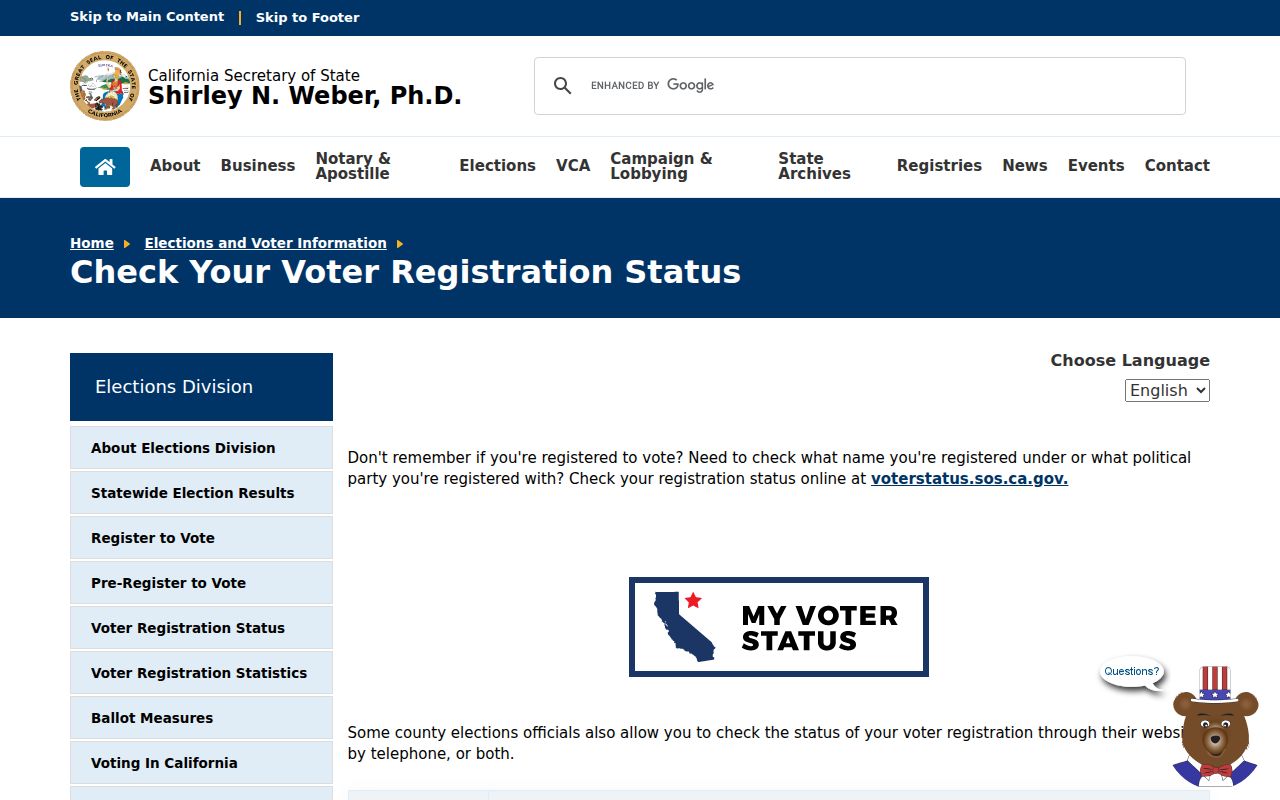
The page connects Palm Springs voters to the county phone fallback without implying that Riverside offers an open public voter search.
Requesting Palm Springs Voter File Data
The California application gathers enough detail to test eligibility and protect the data. It asks for the applicant’s full name, phone, email, business address, mailing address when different, and beneficiary information when applicable. Applicants select an organization type and purpose, provide a detailed use and security explanation, specify the geographic or record scope, and choose whether to include inactive records, voting history, or precinct-to-district data.
- Complete the official voter-file application. State the approved purpose, requested scope, and security controls in concrete terms.
- Attach a clear copy of a current driver license or state identification card. Initial the agreements, add the required original signature, then mail or hand-deliver the form; fax and email submissions are not accepted.
- Select delivery details and submit payment. Statewide files cost $15 per 1,000 records up to $100, while a specific voter record costs $30 each, up to ten records and a $100 maximum.
A request for the full statewide file carries a $100 fee. The form can also identify up to ten specific voters using full name, date of birth, county of residence, and residence address. Those are application fields used to identify requested records, not verified inputs for the My Voter Status portal.
Palm Springs Voter File Delivery
The Secretary of State says review and processing may take seven to fourteen business days after receipt, with requests handled in the order received. Approved county, statewide, or district data is distributed on an encrypted DVD. It arrives as three plain-text, tab-delimited files: voter data, voting history, and district data. Specific voter-record requests arrive by email in an encrypted WinZip attachment.
These are data files, not a polished Palm Springs directory. The agency does not provide end-user technical support for processing them, and it issues no refund after data has been extracted and sent. Applicants should plan secure storage before ordering, limit access to approved users, and be prepared to work with tab-delimited records without uploading them to an unsecured service.
Palm Springs Voter Record Penalties
California forbids using voter information for an unapproved purpose. The state application also bars harassment of a voter or household, commercial advertising or marketing, unsecured online or offline publication, and transfer to another person without a new application and written approval, except for an approved vendor arrangement. Phone numbers may not be used for text advertising without an opt-out.
Elections Code section 18109 makes misuse a misdemeanor and allows significant fines. Every applicant and beneficiary agrees to legal-use, security, and breach-notification terms. Palm Springs voter records must therefore remain within the exact purpose approved by the Secretary of State. They cannot become a neighborhood contact list, a sales file, or a tool for targeting or intimidation.
Use stays narrow. Never publish, sell, transfer, or use Palm Springs voter data to harass a person or household. Approval for one purpose does not authorize another.
Historical Palm Springs Voter Records
No official online collection of historical Palm Springs or Riverside County poll books, precinct books, or voter-registration registers was confirmed in the project research. That gap should not be filled with a made-up archive or coverage date. Researchers tracing past civic participation need to verify holdings with the California State Archives, Riverside County archival contacts, or local library collections before planning a visit or request.
Modern statewide voter data should not be treated as a substitute for historical rolls. Record status, status reason, registration date, and county can describe a current regulated record, while an old poll book may follow different access rules and formats. Ask the holding archive for a collection title, jurisdiction, election year, access restriction, and reproduction policy before relying on it.