
Which Palm Springs Records Are Open
Palm Springs public records are divided by the work each agency performs. City Hall keeps council, board, permit, code, and municipal files. Riverside County holds deeds, assessor data, county certificates, and jail information. Riverside Superior Court controls its own case records. State offices supply business, license, incarceration, and other statewide searches. Public access ranges from a free web index to an eligibility-limited certificate application.
| Record group | Record keeper | Web starting point | How access works |
|---|---|---|---|
| City, police, and permit files | Palm Springs City Clerk or department | JustFOIA and Palm Springs Online | Repository, department workflow, or CPRA request; exemptions may apply |
| Deeds, liens, maps, and official documents | Riverside County ACR Recorder | Records Index Search | Online search and paid copies; office, mail, and drop-box options |
| Parcel and assessor maps | Riverside County ACR Assessor | RivCoView | Free APN or address search; hard-copy map available by mail |
| Civil, criminal, family, and probate cases | Riverside Superior Court | Public Access | Free case-number search, paid name and document searches, certified-copy request |
| Birth, death, and marriage certificates | RUHS Public Health, Riverside ACR, or CDPH | Application pages, not a public county index | Authorized or informational copies; confidential marriage is restricted |
| Custody and registry information | Riverside Sheriff, CDCR, or California DOJ | JIMS, CIRIS, and Megan's Law | Limited public results with purpose and misuse restrictions |
Open does not mean every field or document is exposed. Juvenile, sealed, adoption, protected-address, and some investigative records are restricted. Confidential marriages are limited to the spouses. Voter data is not an open public directory, and court files may be sealed, purged, or withheld under specific law. The custodian decides what can be released and which parts must be redacted.
Palm Springs City Records Channels
Municipal records belong with the city, not the county recorder. The Palm Springs City Clerk accepts California Public Records Act requests through JustFOIA and by phone, email, or in person. Useful request details include the department, record title, date range, address, permit number, meeting date, or report number. Council actions, boards and commissions, claims, ordinances, and transparency files may also be available through the clerk's document tools.
Police files follow a narrower path. Any person may ask for a record, but juvenile, victim, criminal-history, accident, and investigative material can be governed by separate statutes and exemptions. Building Safety records are often keyed to an address, project, permit, applicant, or contractor. Palm Springs Online handles current permit applications, while a records request is the fallback for files not exposed through that service.
Submit a municipal request through the Palm Springs JustFOIA portal. A focused description gives city staff a sound way to locate the right file without forcing a broad search across unrelated departments.
Note: A city-held record in Palm Springs is not automatically releasable; the content and governing statute control disclosure.
Palm Springs Recorder Records Access
The Riverside County Assessor-County Clerk-Recorder maintains the official-record system for Palm Springs deeds, liens, maps, trust documents, notices, and other recorded instruments. An instrument is a document placed in the official record. The portal supports name, document number, document type, map book and page, and advanced searches. Copies can be placed in a cart after a result is found. The Riverside ACR official-record landing page shows the available search modes.
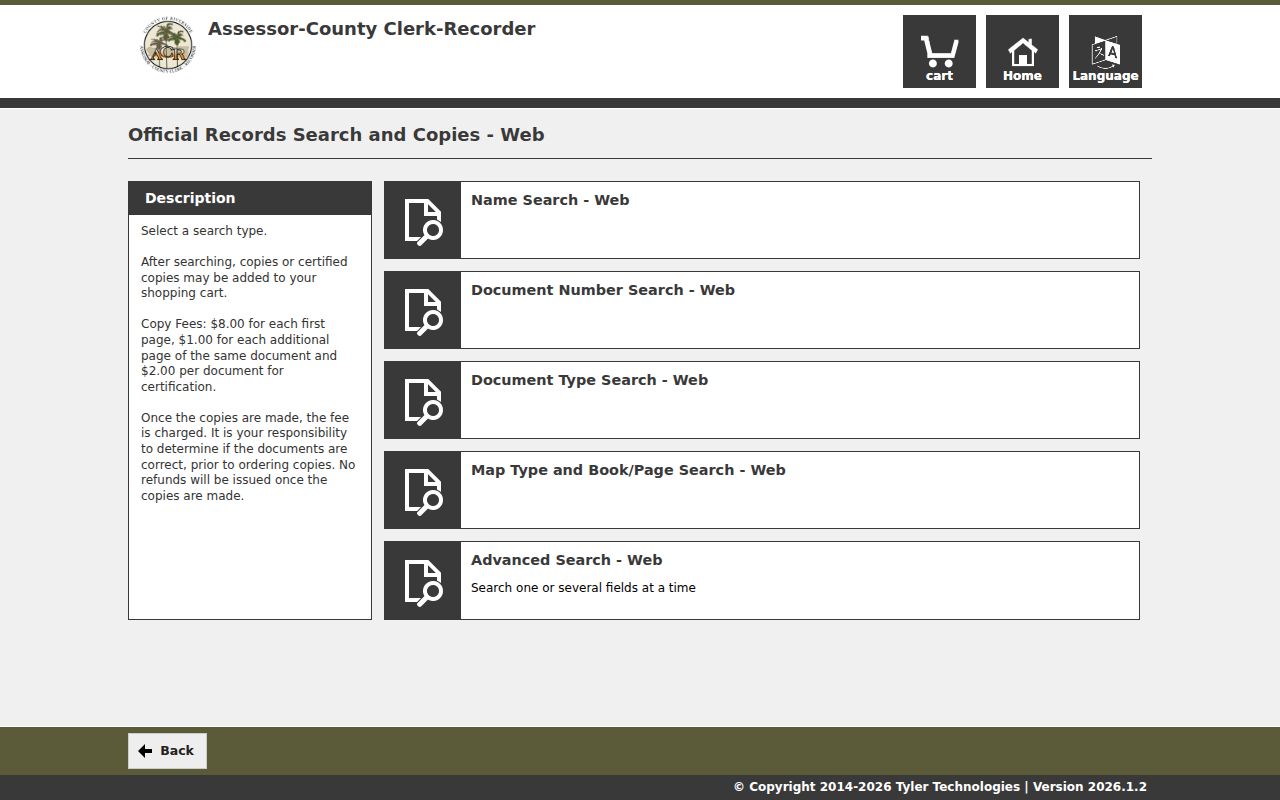
That landing screen is the gateway to both index searches and the paid copy workflow. The official-record fee is $8 for the first page, $1 for each added page of the same document, and $2 to certify a document. Online orders average 48 hours. The charge becomes final once copies are made, so confirm the party, date, type, and document number before ordering. The ACR copy request instructions also document online, mail, drop-box, and public-counter access.
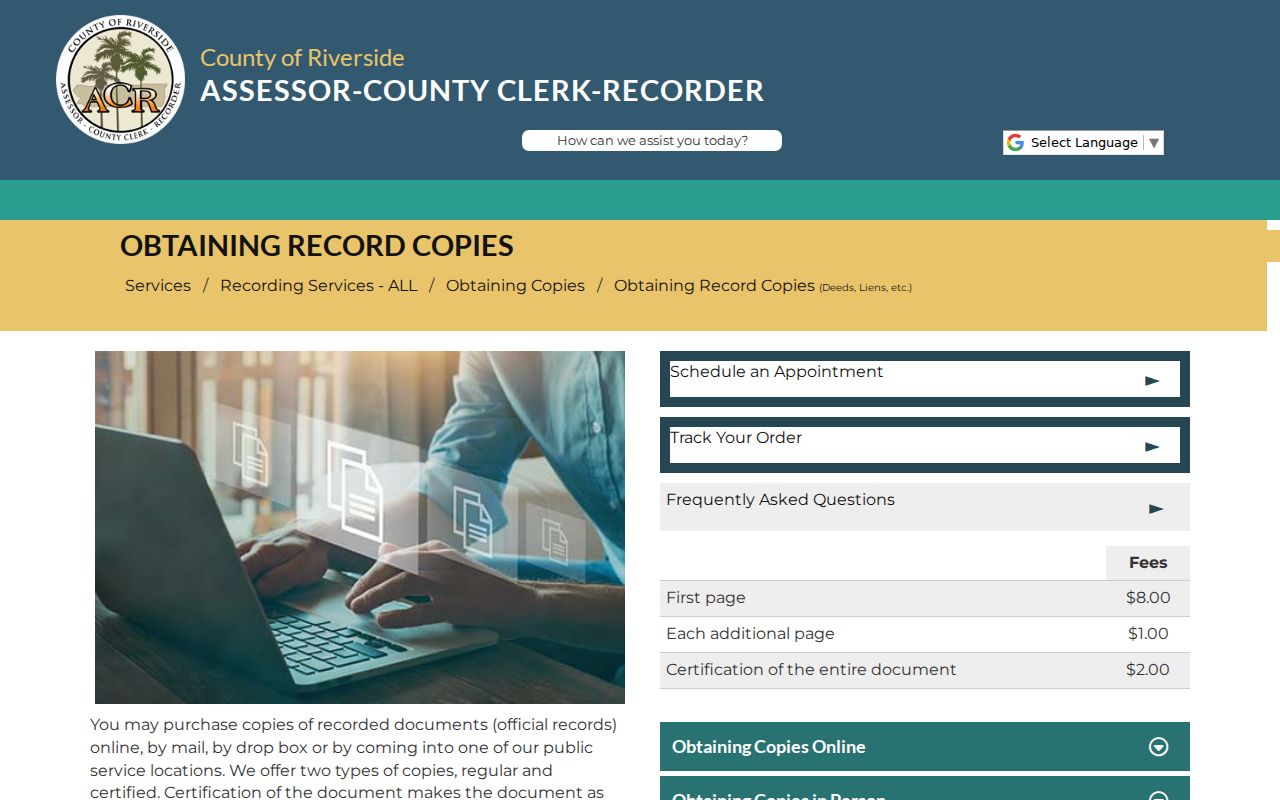
The copy page matters when an index hit is only the first step and a plain or certified image is needed.
Palm Springs Records Search Fields
A name search works best in the recorder's stated format: last name, first name, and middle initial, with no punctuation for an exact match. A broad search can use a last name and first initial. Organization names should be entered as spelled. Recording dates and document types can narrow a common name, while the document-number mode requires the year, a dash, and a number with leading zeros.
| Portal field | When required | Format or use |
|---|---|---|
| Search type | Required | Name, document number, document type, map book/page, or advanced search |
| Name | Conditional | Enter an individual as Last First MI; use a first initial for a wider result |
| Recording date start/end | Optional | Use mm/dd/yyyy to set a date range |
| Document types | Optional | Autocomplete filter for the kind of recorded instrument |
| Advanced name searching | Optional | Enables exact, wildcard, sounds-like, and fuzzy search help |
| Document number | Document mode only | Use YYYY-number and keep leading zeros |
The recorder's Palm Springs name-search screen displays the principal party and date controls.
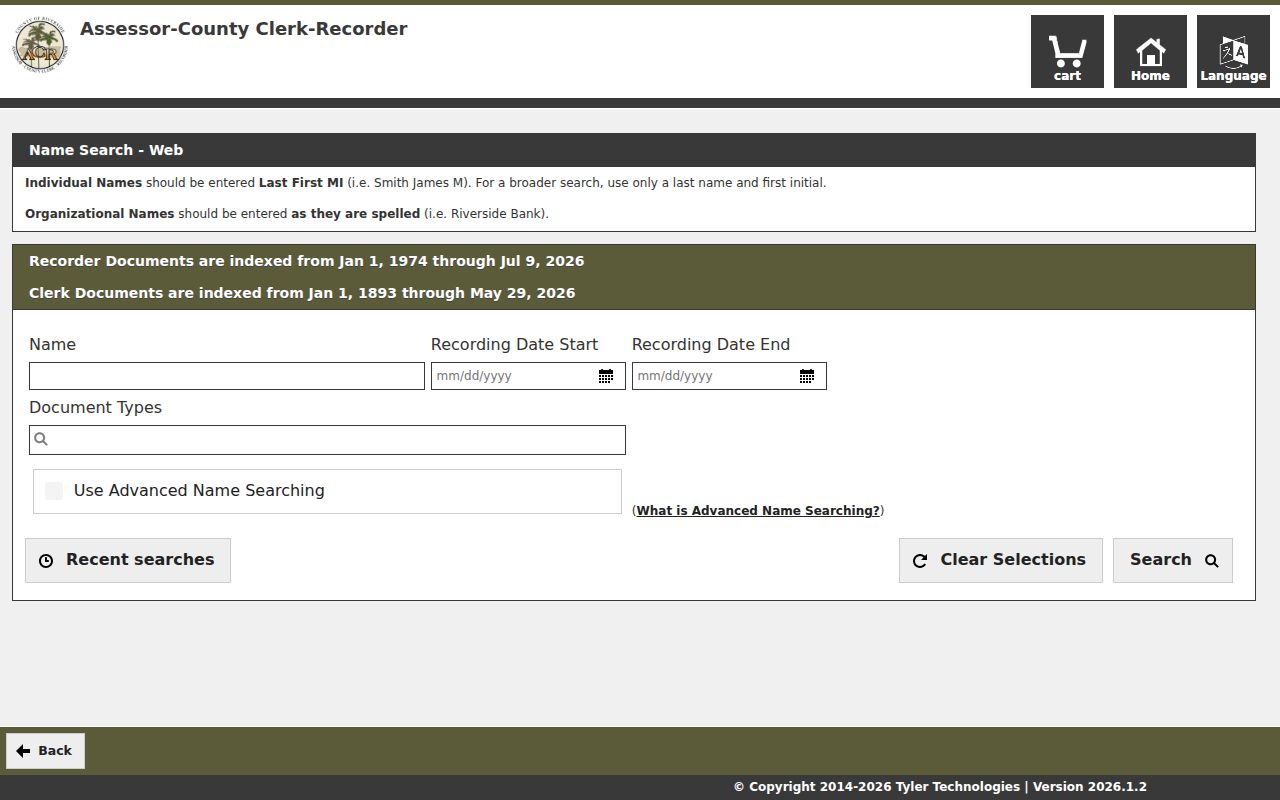
Those fields help separate people with similar names before any copy fee is paid.
Note: Search the index before ordering because Riverside ACR does not refund charges after the selected copy has been made.
Palm Springs Records Cross Two Counters
The nearest ACR service counter is in Palm Desert at 38-686 El Cerrito Road. It provides official-record and vital-record copies, assessor maps, recording services, marriage services, and a drop box. Its public hours are 8:00 a.m. to 4:30 p.m. Palm Springs residents do not need to travel to the county seat for every routine county record.
Older recorder research changes the route. ACR office computers search records from 1975 forward at any office. Documents from 1974 and earlier must be searched at Gateway Riverside. This split is crucial for a long deed chain or estate inquiry. Mail requests for pre-1976 documents also need a close date estimate because staff limit the search to two years after the estimated recording year.
If no document number is known, include the document title or type, every party name, an estimated recording date, and a parcel number when available. Mail requests go to the Riverside County Clerk-Recorder Certified Section at P.O. Box 751, Riverside, CA 92502-0751 and take about one to two weeks.
Palm Springs Property Records and Maps
RivCoView starts with either a nine-digit PIN or APN entered without dashes, or a property address using the street number and street name. APN means assessor parcel number, the county's unique parcel key. The public entry screen does not show an owner-name field. It should not be treated as a guaranteed owner-name search.
Assessor maps show parcel numbers, lot boundaries, dimensions, acreage, street widths, adjacent parcels, and recorded map details. They do not display street addresses or ownership. Use the parcel number from the map to reach the property report, then use the recorder index for deeds, notices, liens, and the document trail. A hard-copy assessor map costs $8 by mail. Map My County adds geographic context when city limits, districts, or nearby unincorporated land cause confusion.
Parcel check. Verify what a live RivCoView report shows before relying on an ownership or mailing-address field; those result fields were not visible on the public entry screen.
Palm Springs Court Records Access
Riverside Superior Court Public Access separates a free case-number search from paid civil and criminal or traffic name searches. A case-number result opens the register of actions, which is the dated list of filings and events in the case. Name results provide matching case numbers and filing dates. Nonconfidential, unsealed documents may be downloaded when the California Rules of Court permit it. The court's records access page states the coverage ranges, costs, and certified-copy distinction.
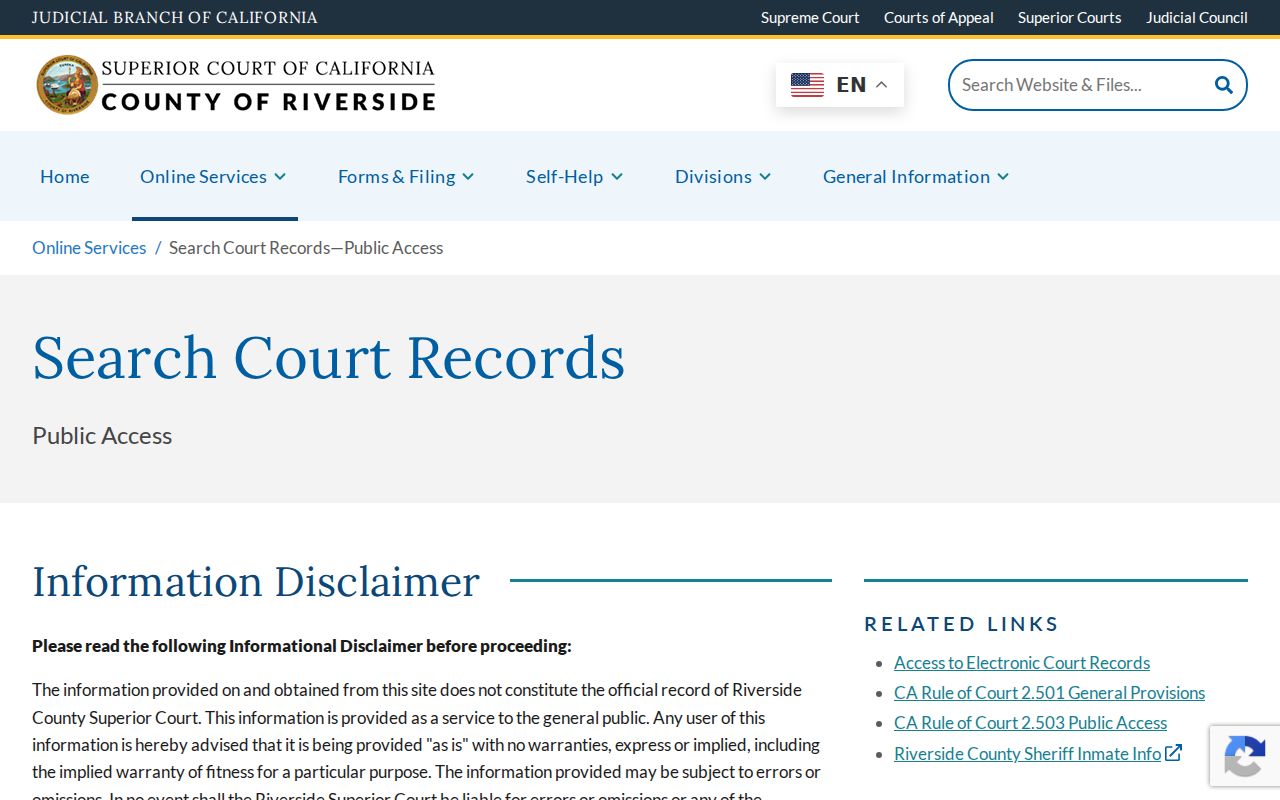
The notice explains why an online docket is useful for finding a case but cannot replace a certified court copy. Name-search credits cost $1 for one, $3.50 for five, and $5 for 10. Document downloads cost $1 per page for the first five pages, then 50 cents per page, capped at $50 per document. Palm Springs civil coverage begins in September 1993. Family coverage includes almost all cases from April 1992, and probate includes almost all cases from July 1994. Palm Springs, Indio, and Blythe misdemeanor data reaches back to September 1993. Certified copies require form RI-MC011 through eSubmit, or a mail, drop-box, or counter request to the proper courthouse. The Riverside court Public Access portal links case, name, document, calendar, and copy tools.
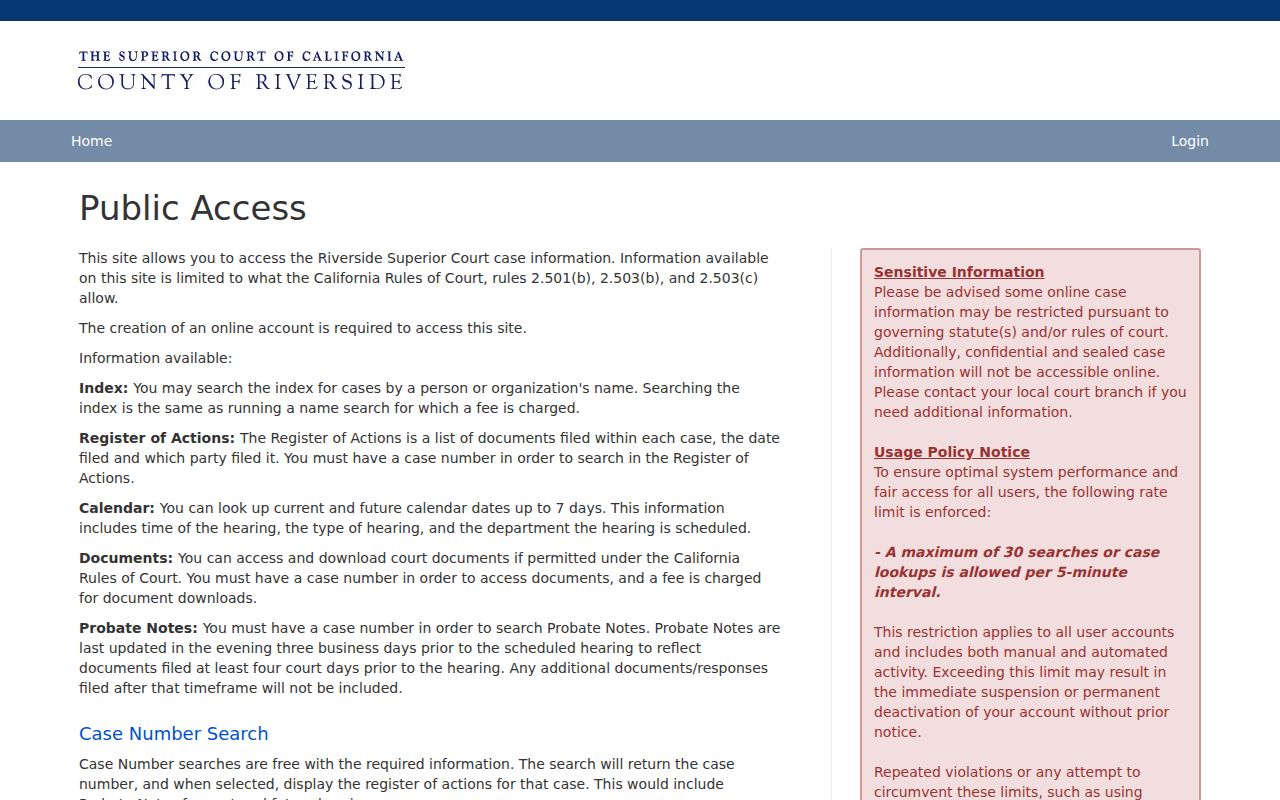
Choosing the correct tool can avoid a paid name search when the case number is already known.
Palm Springs Vital Records Copies
Birth and death records for the current and prior year begin with Riverside University Health System-Public Health. Riverside ACR issues county birth, death, and marriage certificates after records reach the recorder, usually within four to six weeks of the event. CDPH maintains California records statewide and reports an average five-to-seven-week certified-copy processing time. It has no direct electronic request portal of its own. California offers Authorized and Informational copies. An Authorized copy requires eligible status plus identity verification or a notarized sworn statement. An Informational copy cannot be used as an identity document.
Confidential marriage certificates come only from the county that issued the license and only the two spouses may obtain them. Riverside's 2026 fees are $34 for a birth certificate, $26 for a death certificate, and $19 for either a public or confidential marriage certificate. Requests may be made online, in person, by mail, or through a listed drop box. The search fee is not refunded when no record is found. The Riverside vital-record application page sets out the copy types, fees, and identity steps.
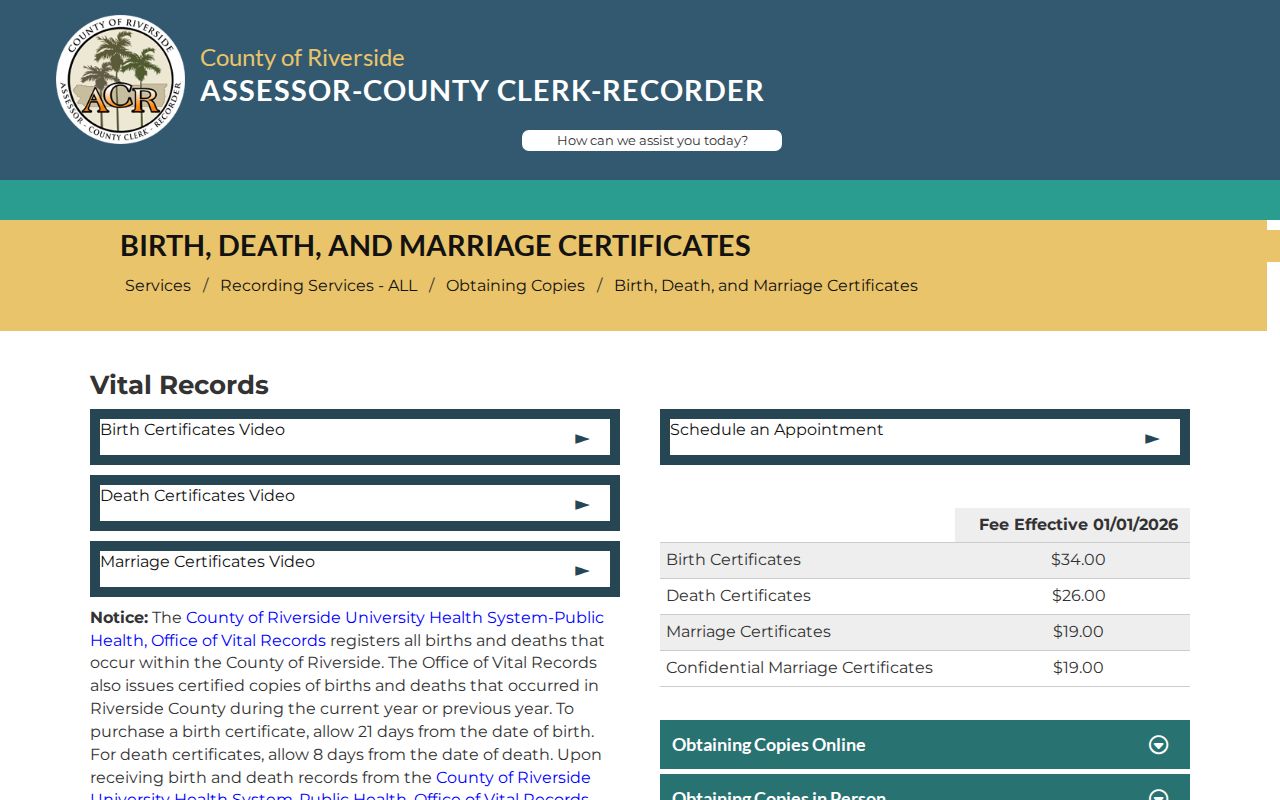
The application route replaces a public name index and preserves the authorized-versus-informational copy rules.
Note: A Certificate of No Record documents an unsuccessful search, but Riverside keeps the certificate search fee.
Palm Springs Custody Records Limits
The Riverside County Sheriff Inmate Information System is a current booking-number tool. Last name is mandatory, while first name and date of birth can narrow the result. California's CIRIS search covers people currently in CDCR custody and can return a name, CDCR number, age, current location, commitment counties, admission date, and parole-hearing facts. The CDCR Identification Unit is the phone fallback for common names when a date of birth is available.
The California DOJ Megan's Law database is updated daily for specified registrants. It has strict legal-use terms and is not a broad people directory. Registry information must never be used to threaten, harass, or support vigilantism. Palm Springs police reports follow a request process rather than a general case portal, and disclosure depends on the record and the police-specific law that governs it.
Note: A current custody lookup does not establish a full case history or substitute for the court's official record.
Palm Springs Records for Heir Research
An estate inquiry often crosses record systems. Probate case data can identify a case number and filing trail. A death certificate confirms the event, while the deed chain can show the owner of a Palm Springs parcel and later transfers. State unclaimed-property records may preserve a name, former place, or estate connection when funds were turned over to California.
Use each record for its proper role. The court portal offers probate coverage from July 1994 forward, but older files may require a court or archive request. Vital copies carry eligibility rules. Recorded documents can name trusts and parties but do not prove a family relationship on their own. Obituaries and historical sources may add context, yet key facts should be confirmed with the custodian's copy.
This is a lawful personal use of official records. Sensitive details from probate and death records should not be republished in a way that exposes or harms living relatives.
Palm Springs Public Records Offices
Three local and county contacts cover most Palm Springs records work. City Hall handles municipal requests. The Palm Desert ACR counter is the closest full county clerk, recorder, assessor, and certificate location. The Palm Springs Courthouse handles local court services, although the right courthouse depends on the case.
Palm Springs City Clerk
3200 E Tahquitz Canyon Way
Palm Springs, CA 92262
(760) 323-8204
Riverside ACR Palm Desert
38-686 El Cerrito Rd.
Palm Desert, CA 92211
(951) 955-6200
Palm Springs Courthouse
3255 E Tahquitz Canyon Way
Palm Springs, CA 92262
(760) 393-2617
Call before a visit when older files, a certified copy, or a large request may need added research. ACR phone service runs 8:00 a.m. to 5:00 p.m. Monday through Friday, while the Palm Desert public counter closes at 4:30 p.m.
Note: The proper court location follows the case, so confirm the courthouse before mailing a certified-copy request.
Palm Springs Records Terms
Records systems use short terms that change what a requester receives. An index entry may be enough to identify a file, but legal or estate work often calls for the image or a certified copy. These terms keep the request precise.
- Custodian
- The agency or office responsible for keeping and responding for a record.
- Index
- A searchable list of record facts, such as names, dates, document type, or case number. It is not the full document.
- Image
- A view or copy of the filed or recorded document itself, subject to access rules and redaction.
- Certified copy
- A copy authenticated by the custodian as a true copy of its official record.
- Exemption
- A law that permits or requires an agency to withhold a record or part of it.
- Redaction
- The removal of protected details while the rest of a releasable record is provided.
Request Palm Springs Public Records
The California Public Records Act, Government Code section 7920.000 et seq., applies to city and county agencies. Under section 7922.535, an agency generally has 10 days to decide whether it holds disclosable records and notify the requester. Unusual circumstances may extend that initial determination by up to 14 days. That period is not a firm production deadline. Review, redaction, volume, and format can affect delivery.
- Choose the custodian. Send city files to Palm Springs, recorded and assessor files to ACR, and case files to the court.
- Check the proper index. Capture a document, parcel, permit, report, or case number when one is available.
- Describe the record. Give names, dates, department, address, document type, and a narrow date range. Ask for an existing record, not research or an explanation.
- Select the copy form. State whether inspection, an electronic file, a plain copy, or a certified copy will meet the need.
- Review the response. If material is withheld, read the cited exemption. Narrow an overbroad request or seek legal review when a custodian wrongfully withholds a record.
Inspection is the basic access premise, though agencies may charge permitted copy costs and certain data extraction or programming costs. Recorder, court, and vital-record orders use their own fee schedules and forms rather than a general CPRA request.
Lawful personal use. Access Palm Springs public records for civic review, family history, estate work, consumer safety, or other lawful purposes. Never use a record to stalk, harass, threaten, or harm a person.